 Skip to content
Key Highlights
- On Nov 18, the U.S. Banking Regulator, OCC, released a statement, stating that banks can now hold digital assets to pay blockchain fees
- With new guidance, Banks will be able to hold small reserves of digital assets like Bitcoin or Ethereum
- As major U.S. banks are preparing to integrate crypto-related services in the upcoming months, this regulatory clarity will bring much-needed clarity for them
On November 18, the United States government gave national banks the green light to hold cryptocurrencies on their balance sheets.
The announcement comes from the Office of the Comptroller of the Currency, which declares that the new guidance will allow banks to hold digital currencies like Bitcoin and Ethereum to pay for blockchain network fees (also known as Gas Fees).
What Does This Statement Mean for Banks
This statement from the OCC will provide much-needed clarity to banks to integrate digital assets into their existing financial infrastructure.
When banks offer services like holding crypto for clients or issuing their own digital dollars, they need a small reserve of crypto to pay for transaction validation on networks like Ethereum.
(Source: occ.treas.gov)
Before this rule, there was ambiguity for banks, and in some cases, they required special permission for these holdings. It slowed down the integration of new digital asset innovations like stablecoin.
But now with the new rule, they can now plan for these costs as a standard part of their business.
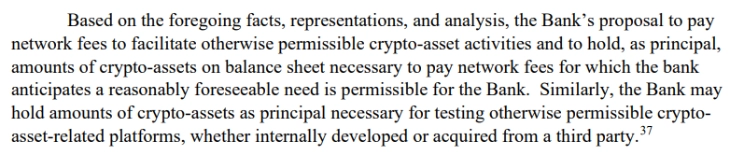
“The OCC published Interpretive Letter 1186 confirming that a national bank may pay network fees, sometimes referred to as “gas fees,” on blockchain networks to facilitate otherwise permissible activities and hold, as principal, amounts of crypto-assets on balance sheet necessary to pay network fees for which the bank anticipates a reasonably foreseeable need. The OCC also confirms that a national bank may hold amounts of crypto-assets as principal necessary for testing otherwise permissible crypto-asset-related platforms, whether internally developed or acquired from a third party,” stated in the official announcement.
A Year of Major Crypto Policy Developments in the US
This decision by the OCC is the latest in a series of pro-crypto reforms from the U.S. government in 2025, thanks to U.S. President Donald Trump and his new administration.
This evolution started in January 2025 with an executive order from President Trump, in which he revealed his intention to make the US a crypto capital of the world.
Not just flowery promises, he also directed his administration to bring much-needed regulatory clarity with clear guidelines.
One of the major actions this year includes a joint statement from the SEC and CFTC in March, where they removed previous warnings for banks to join the bandwagon of crypto opportunities.
In July, the U.S. President signed the GENIUS Act into law, which became the first federal rules for stablecoins. These are digital currencies pegged in a 1:1 ratio with underlying assets like USD. This law mandates that stablecoin issuers must hold enough cash reserves to back every token they launch. This regulation also brings these stablecoin issuers under regulatory oversight.
Not only this, but other new laws have clarified which government agency regulates different types of digital assets. This has ended the tussle between regulatory agencies like CFTC and SEC to decide which cryptocurrencies fall into which regulatory umbrella.
Major U.S. Banks Prepare to Launch Crypto Services
While the cryptocurrency sector is finally getting regulatory clarity, many American financial institutions and banks are rushing to integrate crypto-related services into their existing financial infrastructure.
JPMorgan Chase is planning to expand its crypto custody services through a partnership with Coinbase by early 2026. It also prepares to accept Bitcoin and Ether as collateral from institutional clients for loans.
A group of major banks, like J.P. Morgan, Bank of America, Citi, and Wells Fargo, is in the discussion to launch a joint stablecoin backed by the U.S. dollar. Meanwhile, financial custodians like BNY Mellon and State Street are building new platforms to allow spot trading of cryptocurrencies for their institutional clients.
Source link
#OCC #Permits #Banks #Hold #Crypto #Blockchain #Fees
top altcoins, Ethereum alternatives, new cryptocurrencies
crypto trading bots, automated trading strategies, AI in cryptocurrency
Bitcoin mining, Ethereum mining, best crypto mining hardware
Bitcoin news, cryptocurrency latest news, blockchain updates
best crypto wallets, secure Bitcoin wallets, multi-currency wallets reviews
blockchain technology, fintech innovations, decentralized finance (DeFi)
crypto market analysis, Bitcoin price prediction, Ethereum forecast
cryptocurrency predictions, Bitcoin price forecast, crypto trends 2024, crypto trends 2025
live Bitcoin prices, crypto price updates, Ethereum price report
how to trade cryptocurrency, crypto trading strategies, beginner crypto trading
Welcome to “Cryptocurrency Trading,” your comprehensive destination for the latest news and analysis in the world of **cryptocurrencies** and **currency trading**. We provide rich content focused on **market analysis**, **trading strategies**, and **emerging technologies** that impact the **cryptocurrency market**. Join us to discover the **best investment opportunities** in **Bitcoin**, **Ethereum**, and other leading cryptocurrencies. Our goal is to equip you with the information you need to enhance your trading skills and achieve success in the world of **investment**. Follow us for continuously updated content that supports you in making informed decisions.


